Tuesday, March 13, 2012

Stations on Skin

Every week during Lent, my pastor conducts Stations of the Cross on Friday nights.

Sometimes, I just walk around the sanctuary, going from station to station, concentrating on Love's ultimate Sacrifice.

I came upon a very unique presentation of the stations by a truly gifted Christian artist named Scott Erickson. He designed ten different tattoos representing the iconic stops of the Passion.
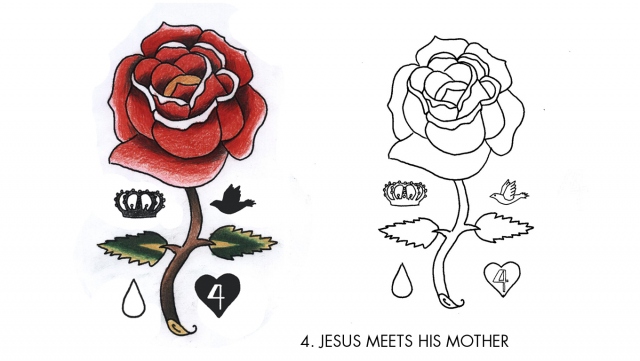
A number of volunteers got inked with the designs. Brilliant photos were taken, printed and enlarged for a gallery. A gallery of the Stations of the Cross. He writes:
"...Around 30 of the tatooees showed up and were the actual living “Stations of the Cross” while hundreds of art enthusiasts came by and interacted with the show.
 It was an awesome night.


...  Before the gallery opening, one of the tattoo participants asked me what the most surprising aspect of the project was. Was it that so many people got tattoos? Thinking about it, my response is that I was surprised by how thankful everyone is who partook in the show by getting a tattoo. Pretty much everyone who got a tattoo thanked me for putting on this project and working hard on the designs. Their tattoo process meant a ton to them and they just had gratitude for being in a community that provided them the chance to get a meaningful tattoo.


There have been many comments from outsiders on this project and everyone feels like they should have a place to say their opinion. Well good for them. For me though, I know this was worth doing for the fruit I’m seeing in this community and in the lives of the people who participated. It’s been such an honor to be able to be involved in this."

 It's such an honor for you to share your work with the world, Scott! I'm actually eying a couple of his designs for my future tattoos. It's getting about that time. :-)

Friday, March 9, 2012

A Love Supremely Spiritual


From NPR:


John Coltrane recorded A Love Supreme in December of 1964 and released it the following year. He presented it as a spiritual declaration that his musical devotion was now intertwined with his faith in God. In many ways, the album mirrors Coltrane's spiritual quest that grew out of his personal troubles, including a long struggle with drug and alcohol addiction.
From the opening gong and tenor saxophone flutter, a four-note bass line builds under the sound. This simple riff becomes the musical framework for the rich improvisations that comprise John Coltrane's 33-minute musical journey.


"I remember they cut the lights down kind of," says McCoy Tyner, who played piano on A Love Supreme as a member of Coltrane's band in the early and mid-'60s. "The lights were dimmed in the studio. I guess they were trying to get a nightclub effect or whatever. I don't know if it was John's suggestion or whatever. I remember the lights being dimmed."

It made sense to try to imitate the dim-lighted intimacy of a club during the studio recordings, he says, because it was on stage during live shows where the quartet would explore, practice and rehearse new material. He says there was an amazing unspoken communication during the "Love Supreme" sessions. In fact, he says, Coltrane gave very few verbal directions. Tyner calls the album a culmination and natural extension of chemistry honed through years of playing together live.

"You see, one thing about that music is that it showed you that we had reached a level where you could move the music around. John had a very wonderful way of being flexible with the music, flexing it, stretching it. You know, we reflected that kind of thing. He gave us the freedom to do that. We thought of something, 'Oh, then we'll play it,' you know? And he said, 'Yeah, I have a feeling'—you know? And all that freedom just came together when we did that record."
It was that free-wheeling openness which allowed the musicians—Coltrane, Tyner, along with drummer Elvin Jones and bassist Jimmy Garrison—to build a complex four-part suite around a relatively basic musical idea.

Lewis Porter heads the masters program in jazz history and research at Rutgers University-Newark. He's the author of John Coltrane: His Life and Music. Porter says that simple idea culminating in the first movement with an unprecedented verbal chant by Coltrane forms the foundation of the entire suite. It's a theme Coltrane consciously uses in subtle and careful ways throughout A Love Supreme.

For example, toward the end of part one, "Acknowledgement," Coltrane plays the riff in every key.
"Coltrane's more or less finished his improvisation, and he just starts playing the 'Love Supreme' motive, but he changes the key another time, another time, another time. This is something very unusual. It's not the way he usually improvises. It's not really improvised. It's something that he's doing. And if you actually follow it through, he ends up playing this little 'Love Supreme' theme in all 12 possible keys," says Porter. "To me, he's giving you a message here. First of all, he's introduced the idea. He's experimented with it. He's improvised with it with great intensity. Now he's saying it's everywhere. It's in all 12 keys. Anywhere you look, you're going to find this 'Love Supreme.' He's showing you that in a very conscious way on his saxophone. So to me, he's really very carefully thought about how he wants to present the idea."

While A Love Supreme is a recognized musical masterpiece, it had enormous personal significance for Coltrane. In the spring of 1957, his dependence on heroin and alcohol lost him one of the best jobs in jazz. He was playing sax and touring with Miles Davis' popular group when he became unreliable and strung out. Alternately catatonic and brilliant, Coltrane's behavior and playing became increasingly erratic. Davis fired him after a live show that April.

Soon after, Coltrane resolved to clean up his act. He would later write, in the 1964 liner notes to A Love Supreme, "In the year of 1957, I experienced, by the grace of God, a spiritual awakening, which was to lead me to a richer, fuller, more productive life."

But Coltrane didn't always stay the clean course. As he also wrote in the album's notes, "As time and events moved on, I entered into a phase which is contradictory to the pledge and away from the esteemed path. But thankfully now, through the merciful hand of God, I do perceive and have been fully reinformed of his omnipotence. It is truly a love supreme."

Read the rest here. Listen below.


Wednesday, March 7, 2012

“A man’s physical hunger does not prove that man will get any bread; he may die of starvation on a raft in the Atlantic. But surely a man’s hunger does prove that he comes of a race which repairs its body by eating and inhabits a world where eatable substances exist. In the same way, though I do not believe (I wish I did) that my desire for Paradise proves that I shall enjoy it, I think it a pretty good indication that such a thing exists and that some men will. A man may love a woman and not win her; but it would be very odd if the phenomenon called “falling in love” occurred in a sexless world.” -C.S. Lewis in "The Weight of Glory"

Tuesday, March 6, 2012

The Harlem Renaissance: Music, Religion, and the Politics of Race

My good friend David told me about this series. If you have some time, listen in and learn. And enjoy!


Sunday, February 26, 2012

Coloring Inside (And Out) of the Lines

I purchased a pack of oil pastel sticks a couple of weeks ago and have been coloring the past couple of days like a little Crayola Kid.


Saturday, February 18, 2012

I Hasten to His Throne...

"I love the the Lord, he heard my cry
And pitied every groan, long as I, I live
And troubles rise, I hasten to his throne"


Rest in peace.

Friday, February 10, 2012

...My Life...

"Ellipsis (plural ellipses; from the Ancient Greek: ἔλλειψις, élleipsis, "omission" or "falling short") is a series of marks that usually indicate an intentional omission of a word, sentence or whole section from the original text being quoted. An ellipsis can also be used to indicate an unfinished thought or, at the end of a sentence, a trailing off into silence, (aposiopesis), example: "But I thought he was..." When placed at the beginning or end of a sentence, the ellipsis can also inspire a feeling of melancholy or longing. The ellipsis calls for a slight pause in speech or any other form of text, but it is incorrect to use ellipses solely to indicate a pause in speech."
Source: Wikipedia